
.svg)
HEO repurposes an Earth observation satellite to conduct sustained proximity operations around a noncooperative rocket body, unlocking a new level of close-range space inspection
.png)
SYDNEY, Australia, [September 14, 2026] — HEO has successfully completed a second Rendezvous and Proximity Operations (RPO) campaign around a noncooperative CZ-2C rocket body, demonstrating that an Earth observation satellite already in orbit can be repurposed for sustained close-range inspection.
The mission moves HEO's Non-Earth Imaging (NEI) capability beyond conventional flyby imaging, giving operators more time, improved imaging conditions and more viewing angles from which to understand an object in orbit.
The mission was conducted in partnership with Satellogic, which supported mission operations, and UNSW Canberra Space, which supported manoeuvre planning and ground-based tracking. The project was supported by funding from Defence Trailblazer’s Advanced Innovation Fund.
Creating better conditions for imaging missions
Until now, HEO's imaging missions have primarily used the flyby technique. As satellites in HEO's network naturally pass near a target, the spacecraft can be pointed towards the object, capture imagery and continue on its trajectory. The resulting observation window is short and constrained by the encounter’s geometry and illumination.
RPO changes that. Rather than simply passing the object, HEO's Continuum-1 satellite moved into close proximity and repeatedly observed the target over an extended period. This gave the mission team greater control over imaging geometry, lighting and relative motion, creating better conditions for inspection and understanding.
Two RPO campaigns, thousands of images
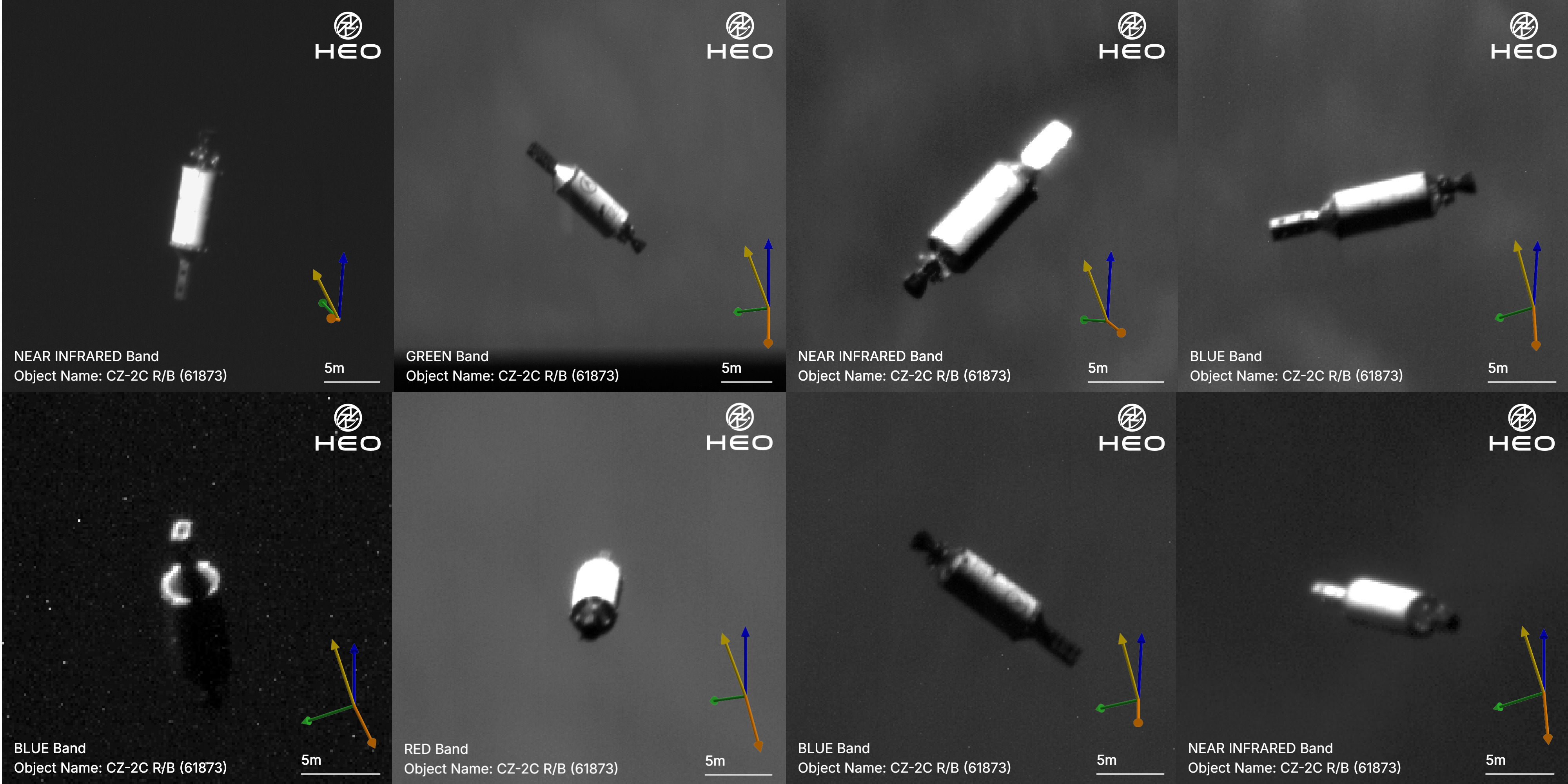
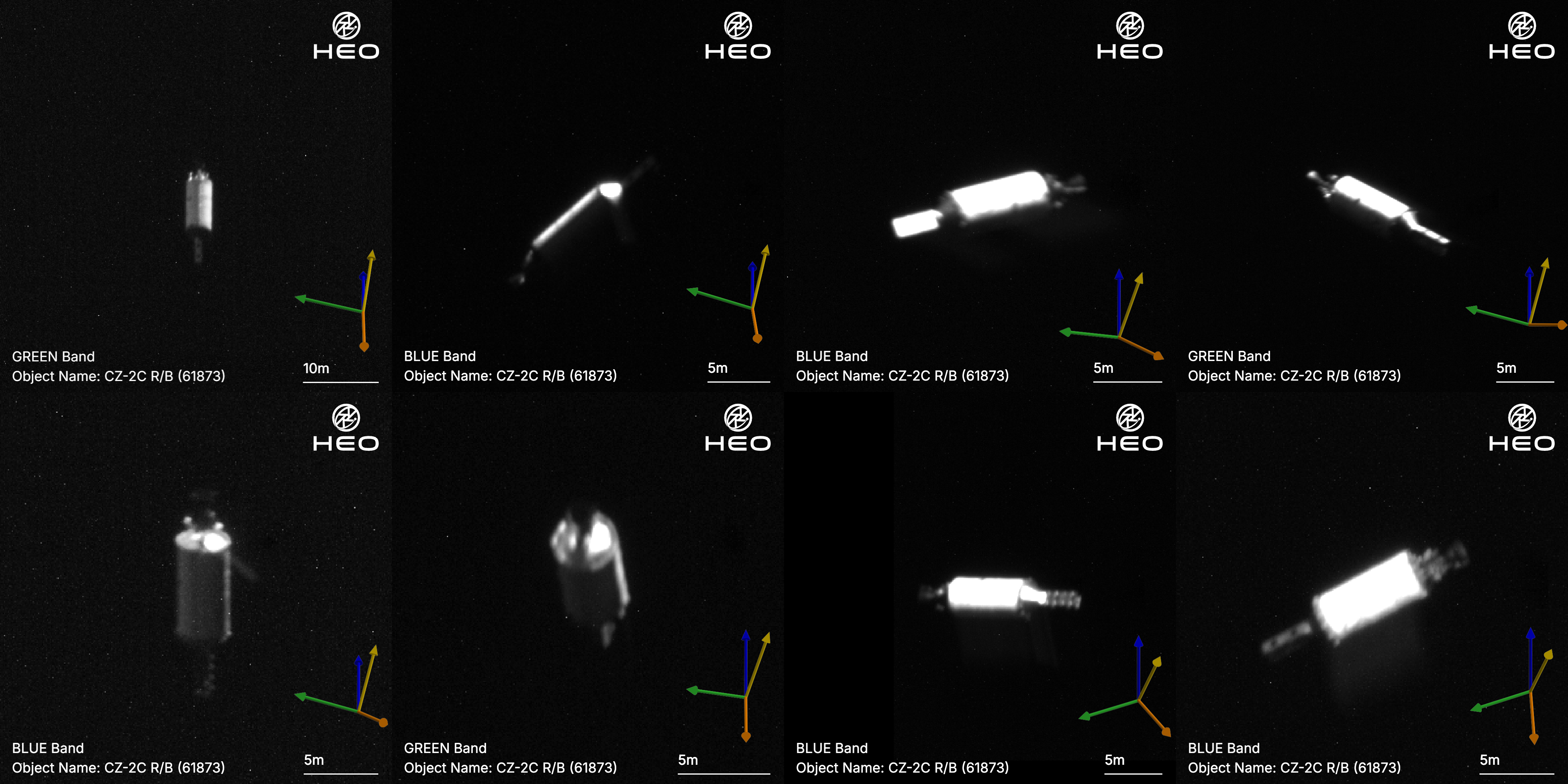
HEO conducted two extended proximity periods around the target. The first ran from August 12 to August 16. HEO shared the first images from this campaign in early September, showing Continuum-1 approaching the target from roughly 40 kilometres at a resolution of 8 cm per pixel. During the second, proximity period, from August 30 to September 4, Continuum-1 naturally drifted back towards the object and came within 27 kilometres of the target, capturing imagery at a resolution of up to 7 cm per pixel.
Across both periods, the spacecraft spent approximately 78 hours within 100 kilometres of the object and 12 hours within 50 kilometres.
By reducing relative velocity, controlling imaging geometry and using active focusing, HEO produced imagery with resolution up to 7 cm per pixel, alongside significantly reduced motion blur and multiple viewing angles across the campaign.
The campaign resulted in over 50 successful imaging missions, comprising thousands of individual image frames.
A few images taken during the first RPO period
A few images taken during the second RPO period
The resulting imagery demonstrated the value of sustained proximity operations, including:
Adapting in-orbit spacecraft for dynamic inspection
The campaign also demonstrated that Continuum-1, which was not designed as a dedicated proximity operations vehicle, could be adapted for dynamic inspection through software, mission planning and disciplined fuel management.
“Nobody is going to launch a purpose-built inspector for every object worth understanding,” said William Crowe, CEO and Co-Founder of HEO. “What matters is how much intelligence you can extract from spacecraft already flying. Working with the team at Satellogic, we positioned an Earth observation satellite next to a tumbling rocket body and kept it delivering intelligence for days without needing to build and launch a new spacecraft. It is a different way to think about what a sensor network is and can produce.”
The mission demonstrates a practical path towards sustained inspection without requiring a purpose-built inspector to be launched for every object. By combining existing spacecraft with mission software, manoeuvre planning and in-orbit imaging expertise, HEO can turn satellites already in orbit into inspection platforms.
Building a foundation for future inspection missions
This capability will become increasingly important as more infrastructure moves into orbit. Satellite servicing, orbital logistics, debris removal and future commercial infrastructure will all depend on spacecraft safely approaching and interacting with one another. Before docking, servicing, relocating or removing an object, operators need confidence in what they are approaching.
The RPO campaign builds on HEO's existing NEI capability and provides a foundation for future inspection missions in low Earth orbit, while supporting the company's path towards proximity operations in geostationary orbit.
Dr Sanjay Mazumdar, Executive Director of Defence Trailblazer, said of the project: “We’re proud to support this innovative campaign, which advances HEO’s capabilities from flyby imaging to proximity operations and provides real-world validation of tactical RPO manoeuvres. The mission showcases HEO’s commercial innovation and has drawn on the expertise developed in domestic missions to-date, including the significant operational capabilities of UNSW Canberra Space. Projects like these are helping to build an experienced Australian space workforce, advancing and uplifting our sovereign space capabilities and security.”
“This project is an example of how we, as a university, can provide direct support to the Australian space industry,” said Associate Professor Melrose Brown. “We have world-class observational capabilities and the expertise within our team to contribute to cutting edge missions like this one.”
The project was delivered in partnership with Satellogic and UNSW Canberra Space and supported by the Australian Government Department of Education through the Defence Trailblazer program.
About HEO
HEO is building the intelligence layer for space. We image objects in orbit on demand, turning existing satellites into inspection platforms and building our own sensors where coverage gaps remain. Our software automates tasking, capture and analysis, turning imagery into decision-ready intelligence about satellites, debris and other objects in orbit. HEO operates internationally, with offices in Australia, France, Japan, the United Kingdom and the United States. Our goal is to make any image in the Solar System available on demand.
Media contact:
Dane Brumm
media@heospace.com
