
.svg)
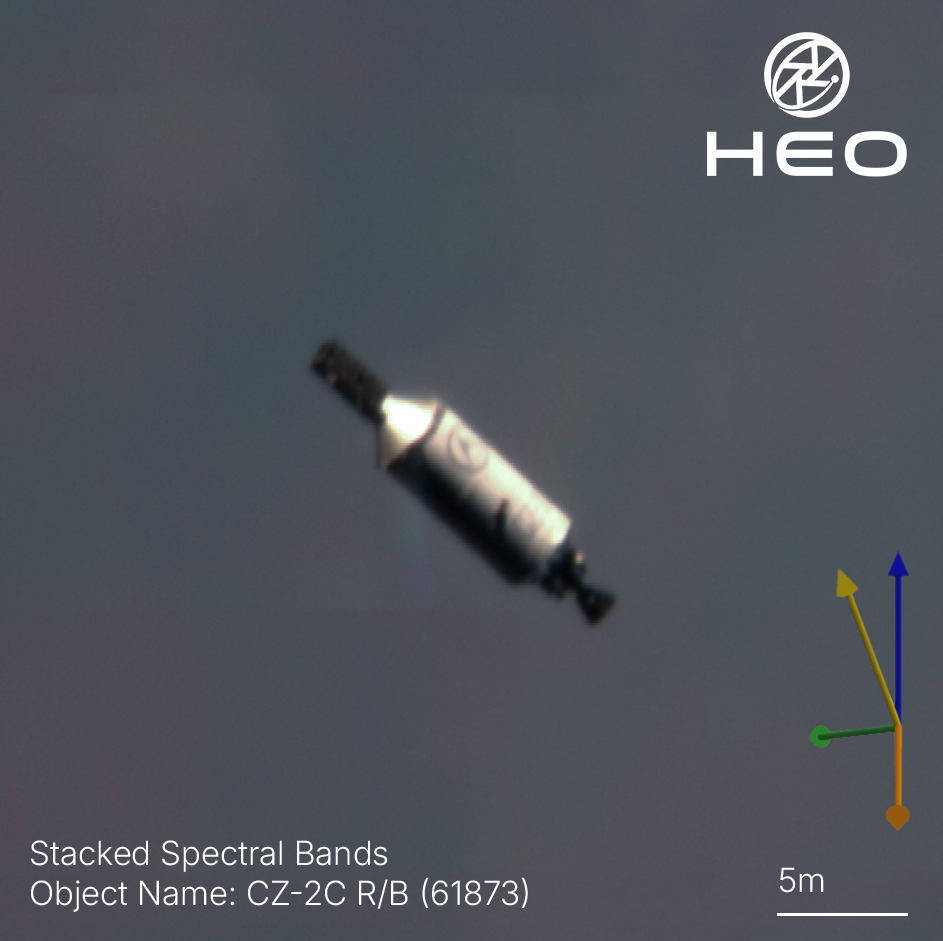
HEO has released one of the first images captured during its first Rendezvous and Proximity Operations (RPO) mission, providing an early look at what becomes possible when we apply our software and in-orbit imaging expertise to repurpose an Earth observation satellite and move in close to an object in orbit.
During the mission, HEO’s Continuum-1 satellite approached and held position relative to a noncooperative CZ-2C rocket body, capturing imagery from approximately 40 kilometres away at a resolution of 8 cm/pixel.
The high-resolution imagery unveils details including the state of the rocket body’s engine nozzle, main body, payload adapter, and behaviour, with the object’s logo and “CZ” markings also visible.
Until now, we have conducted all of our imaging missions using the flyby technique. As satellites in our network naturally pass near the target object, we direct the satellite towards the target, capture images, and continue on. In those instances, we’re limited to a short window in which to observe the satellite, and to whatever illumination and viewing geometry that encounter provides.
Now, instead of passing the object, Continuum-1 can observe it for days and capture imagery from a range of geometries. That gives us more time, more images, and more angles from which to understand what we're looking at and what it’s doing.
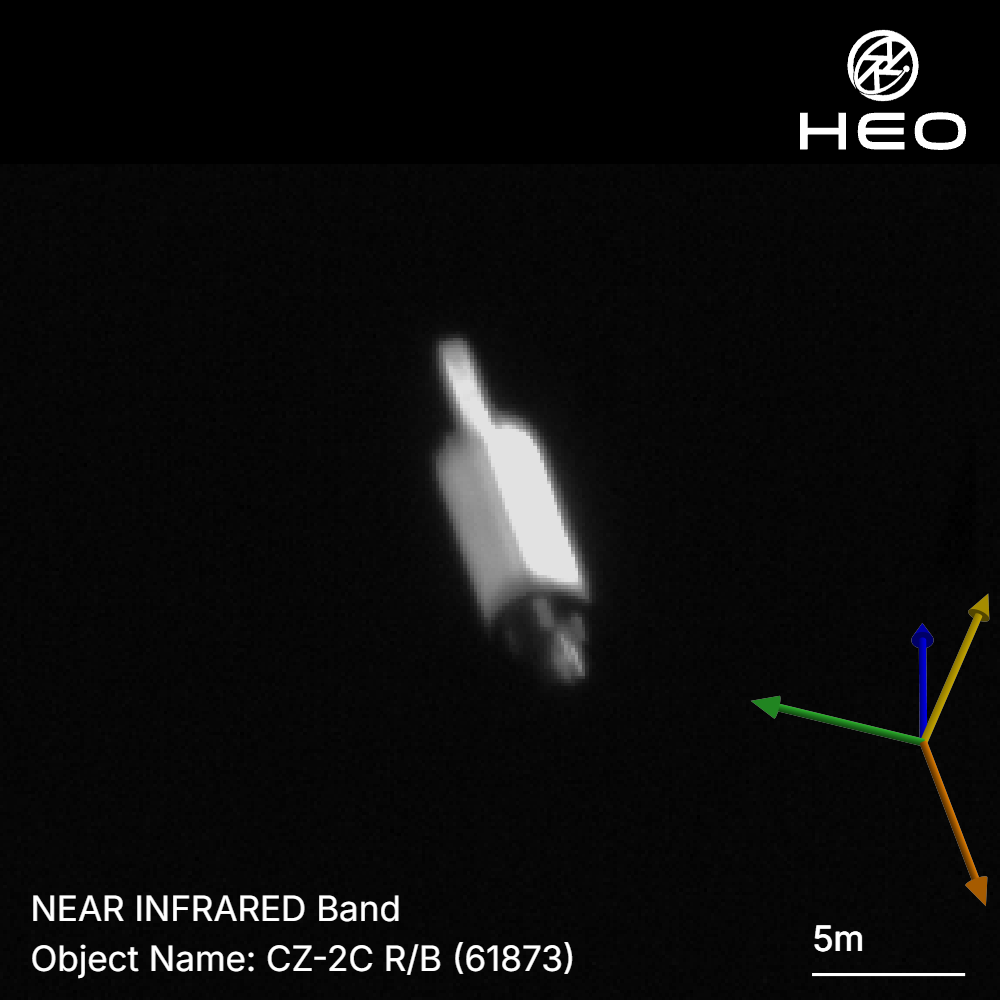
Continuum-1’s mission is HEO’s first attempt to repurpose an Earth observation satellite for RPO around a noncooperative object. It is designed to demonstrate how satellites already in orbit can be adapted for more dynamic operations and, ultimately, how they can contribute to on-orbit services without building and launching new hardware.
The mission was conducted in partnership with Satellogic, which supported mission operations, and UNSW Canberra Space, which supported manoeuvre planning and ground-based tracking. The project was funded through Defence Trailblazer.
Since this image, Continuum-1 continues to hold a close position relative to the rocket body and is capturing additional imagery through controlled proximity operations. HEO will release a set of new images and mission data in a subsequent update.
The project is delivered in partnership with Satellogic and UNSW Canberra and supported by the Australian Government Department of Education through the Defence Trailblazer program.
