
.svg)
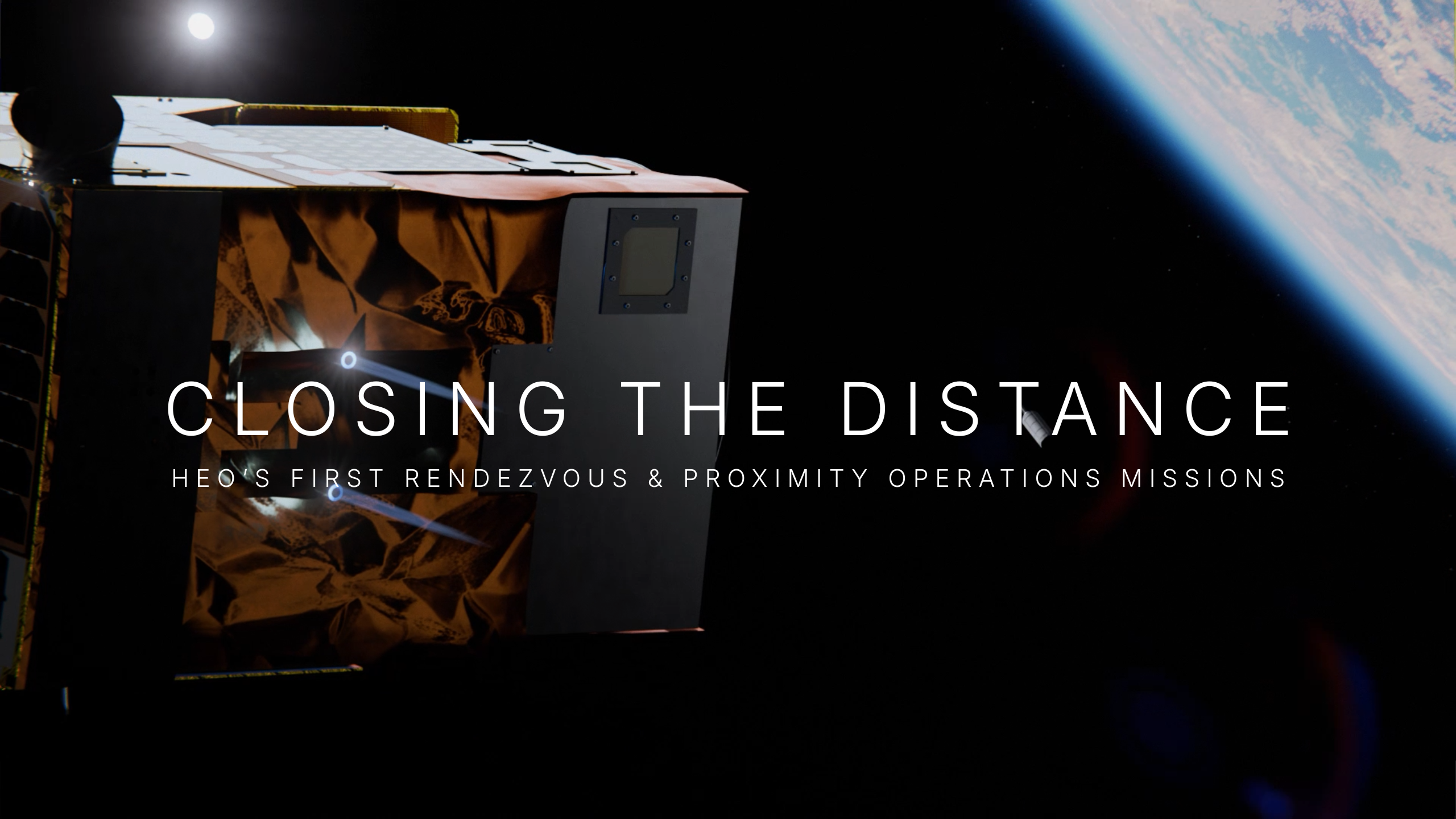
HEO is manoeuvring a satellite into orbit around another object in space for the first time. The technique is called rendezvous and proximity operations, or RPO. It's a capability we've never attempted before, and it changes how long we can watch a target and how closely.
Over the past five years, HEO has captured more than 6,000 successful non-Earth imaging (NEI) missions, spanning over 900 unique objects. In each of these missions, our core collection method has been the flyby NEI, where one satellite images another satellite as they naturally pass close by.
Flyby collection depends on natural orbital convergence. The imaging window is brief and the vantage point uncontrolled. Extending that window usually means designing a dedicated rendezvous and proximity operations (RPO) satellite from the ground up, at significant cost and lead time. HEO's approach instead asks whether an existing satellite, one already on orbit and not built for RPO, can be manoeuvred into position using a fuel-efficient approach. That technique is rendezvous and proximity operations (RPO). Beyond demonstrating the manoeuvre itself, the mission explores how HEO can conduct dynamic space operations while collecting imagery, extending our ability to collect intelligence while actively manoeuvring spacecraft.
Where a flyby captures multiple frames over a few seconds, an RPO holds a satellite in a controlled orbit around another object for an extended period, allowing HEO to control imaging conditions with far greater precision than a single pass allows. Future RPO missions, paired with the right sensor, could extend this to continuous imagery. The target for this mission is an inactive rocket body in low-Earth orbit, a noncooperative object that cannot be commanded or manoeuvred into a more favourable position. HEO selected the target, planned the approach, and is now actively managing the operation with our partners Satellogic and UNSW Canberra.
The spacecraft carrying out the mission was not built for this.
HEO acquired the satellite already in orbit on Christmas Eve 2025, from our partners at Satellogic, for whom it had been an Earth observation platform. Renamed Continuum-1, it carries a camera designed to image the Earth from several hundred kilometres up, not a purpose-built RPO sensor, along with a modest fuel reserve. Rather than build a dedicated RPO spacecraft from scratch, HEO is repurposing an existing platform through software and mission planning, an approach that shrinks a task nation states have historically funded at tens of millions of dollars down toward the low hundreds of thousands.
"Taking a satellite that is already in orbit removes months, sometimes years, of hardware development," said Will Crowe, CEO and co-founder of HEO. "It changes the economics of who can attempt this kind of mission, and how quickly."
A camera built for Earth observation was never going to support a close approach. The question was how close we could get before image quality broke down. The answer, using the onboard camera's hyperfocal distance, is roughly tens of kilometres, well beyond the tens or hundreds of metres a typical rendezvous holds. Closer than that, the image degrades. That limitation became part of the mission design. Instead of forcing a closer inspection, we built the operation around the camera's strengths, demonstrating that an Earth observation sensor can still support an RPO mission and deliver valuable imagery.
Fuel was the other constraint we had to design around. The satellite had limited delta-v remaining at the time of purchase, so the approach is split into three distinct manoeuvre segments, each one slowing the approach further and aligning the relative orbital elements between the two spacecraft more precisely than the last. After each segment, our team updates its orbit determination before planning the next burn. Manoeuvre, refine, repeat. It's a slower approach, but one that builds opportunities for correction into every stage of the mission.
The full operation, phasing through rendezvous, spans roughly four weeks, following six months of planning. We've quantified success as a satellite under HEO's control in a stable orbit around our chosen target. Persistent imagery through the rendezvous is the goal beyond that baseline, capturing the object as the satellite circles it rather than a single pass.
HEO's network already supports a form of pattern of life. Our network of 40+ space-based sensors allows us to revisit a given satellite multiple times a day from different satellites and build a picture across those passes. But each flyby captures tens of frames over a few seconds. Seeing the full 360 degrees of an object takes multiple flybys from different angles, stitched together over captures.
This mission changes the cadence completely. Instead of waiting for isolated flybys, Continuum-1 repeats a similar imaging sequence roughly every 90 minutes over several days. The viewing geometry changes gradually rather than unpredictably, giving us more consistent lighting, longer imaging windows, and a much richer picture of the target over time. Future RPO missions could extend this further, toward the kind of continuous observation a full rotation would require.
In LEO, this kind of sustained observation is uncommon for HEO’s NEI. Objects are moving fast enough that a flyby is a practical option as it balances image quality and the number of objects one satellite can image. Geostationary orbit is different. Objects there hold position relative to Earth, so sustained, close observation is the default condition. HEO has operations planned in GEO to come online in 2027, and this first RPO mission, though flown in LEO against a noncooperative target, is effectively a rehearsal for that operational profile.
The value of this manoeuvre will extend well beyond this demonstration. As commercial infrastructure expands, from servicing vehicles to proposed in-space data centres, operators will increasingly need to inspect hardware up close before making decisions. RPO provides that capability. It creates the conditions for inspection today and lays the groundwork for servicing missions in the future. HEO is now extending into dynamic space operations, demonstrating the ability to capture imagery during complex orbital manoeuvres and creating a new source of operational intelligence for the next generation of space missions.
This is HEO's first attempt at a rendezvous mission. In our years operating in space, we hadn't tried one before.
We are running it in partnership with UNSW Canberra, which is supporting ground-based observation, orbit analysis and manoeuvre planning, as well as providing ground truth data to calibrate domestic sensor networks. This kind of data will help defence analysts tell a routine manoeuvre from one that warrants a second look.
The collaboration doesn't end with this mission. Researchers and students from UNSW Canberra work alongside our operations team, learning the rendezvous planning and mission execution skills that national defence organisations have already identified as strategically important.
The project is supported by the Australian Government Department of Education through the Defence Trailblazer program.
Over the past weeks, Continuum-1 has completed its phasing manoeuvres and is now closing into its final orbit around the target. Satellogic is supporting HEO with mission operations and UNSW Canberra is supporting ground-based observation and manoeuvre planning. If the mission unfolds as planned, it will mark the first time HEO has deliberately placed one spacecraft into a controlled orbit around another object in space.
It began with a question: could an Earth observation satellite already in orbit, first repurposed for NEI, now perform a mission it was never designed to fly? We’re about to find out.
The project is delivered in partnership with Satellogic and UNSW Canberra and supported by the Australian Government Department of Education through the Defence Trailblazer program.
